
June 19 – World Sauntering Day
On World Sauntering Day, we want to remind everyone of the unique therapeutic value of ordinary walking.
The idea originated back in 1979 as an ironic response to the jogging craze: at that time, American W.T. Rabe proposed reminding people that they could simply walk – slowly, aimlessly, and for the sheer pleasure of the process itself.
But walking isn’t just enjoyable. It’s proven to be beneficial. It is an accessible, safe, and effective way to support physical and mental health.
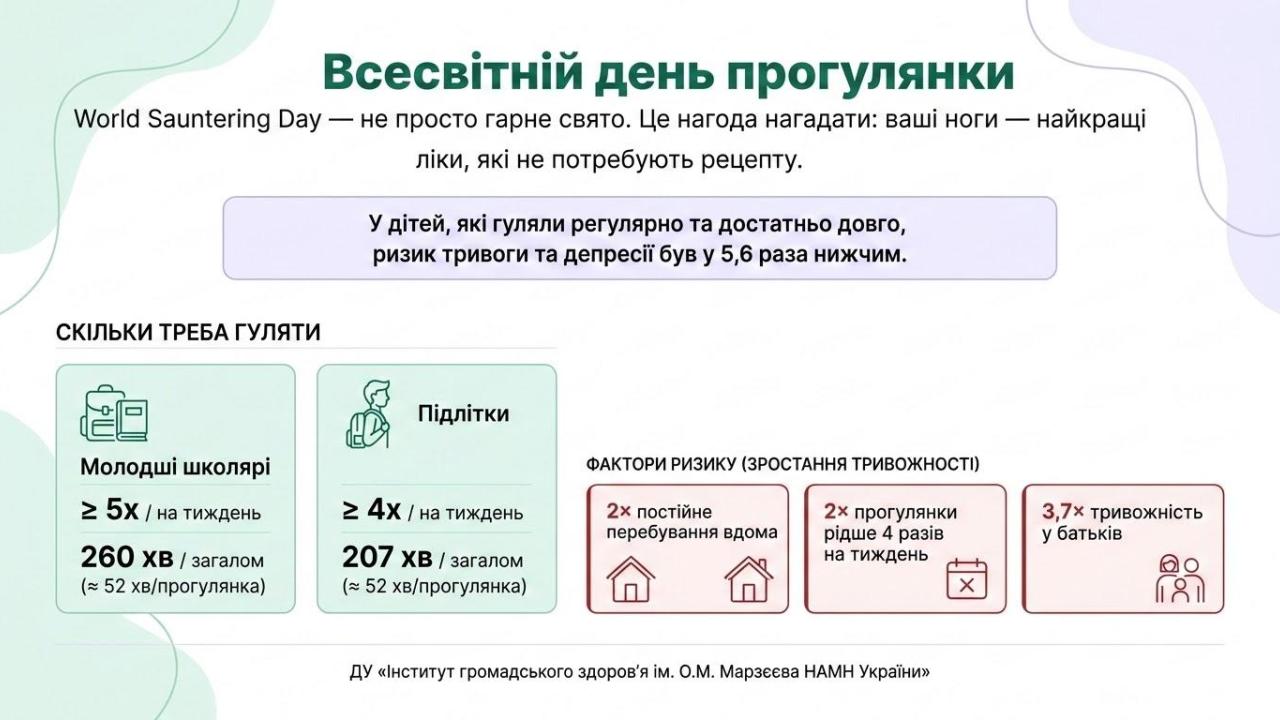
Staff members of the Health Promotion Department at the State Institution «Marzieiev Institute for Public Health of the National Academy of Medical Sciences of Ukraine» investigated the link between walking and the mental health of children and adolescents during the COVID-19 quarantine. It was found that as the duration of walks increased, both anxiety and depression levels decreased; however, this effect is not cumulative but begins when the duration of walks exceeds 200 minutes per week. During quarantine, in the group of children who went for walks less than 4 times a week for less than 220 minutes per week, the likelihood of depressive disorders was 1.9 times higher, and that of anxiety disorders was 2.6 times higher, compared to the group that went for walks more frequently and for longer durations.
Based on the results of this study, recommendations were developed regarding health-promoting physical activity for school-aged children. Specifically, we recommend adhering to the following minimum frequency and duration of walks during times of social crisis: for children aged 6–11, 4–5 times a week for 40–60 minutes; for adolescents, 4 times a week for 50–60 minutes.
https://health.gov.ua/wp-content/uploads/2024/12/recommendations_2024_2.pdf (in Ukrainian)
It is important to note that it is precisely walking outdoors in the fresh air (not sports training, not running) that has been found to be an independent protective factor for maintaining health.
Our data confirm that incorporating regular walks in the fresh air into mental health support programs for children during social crises is well-founded and appropriate.
For more detailed information, see the links below:
https://doi.org/10.32402/dovkil2023.03.062
https://doi.org/10.32345/2664-4738.4.2022.11
Svitlana Hozak, Olena Yelizarova, Tetiana Stankevych
State Institution «Marzieiev Institute for Public Health of the National Academy of Medical Sciences of Ukraine»
(date of publication on the website: 18.06.2026)