
A publication has been released on the features of the water purification process when using chlorine dioxide instead of chlorination
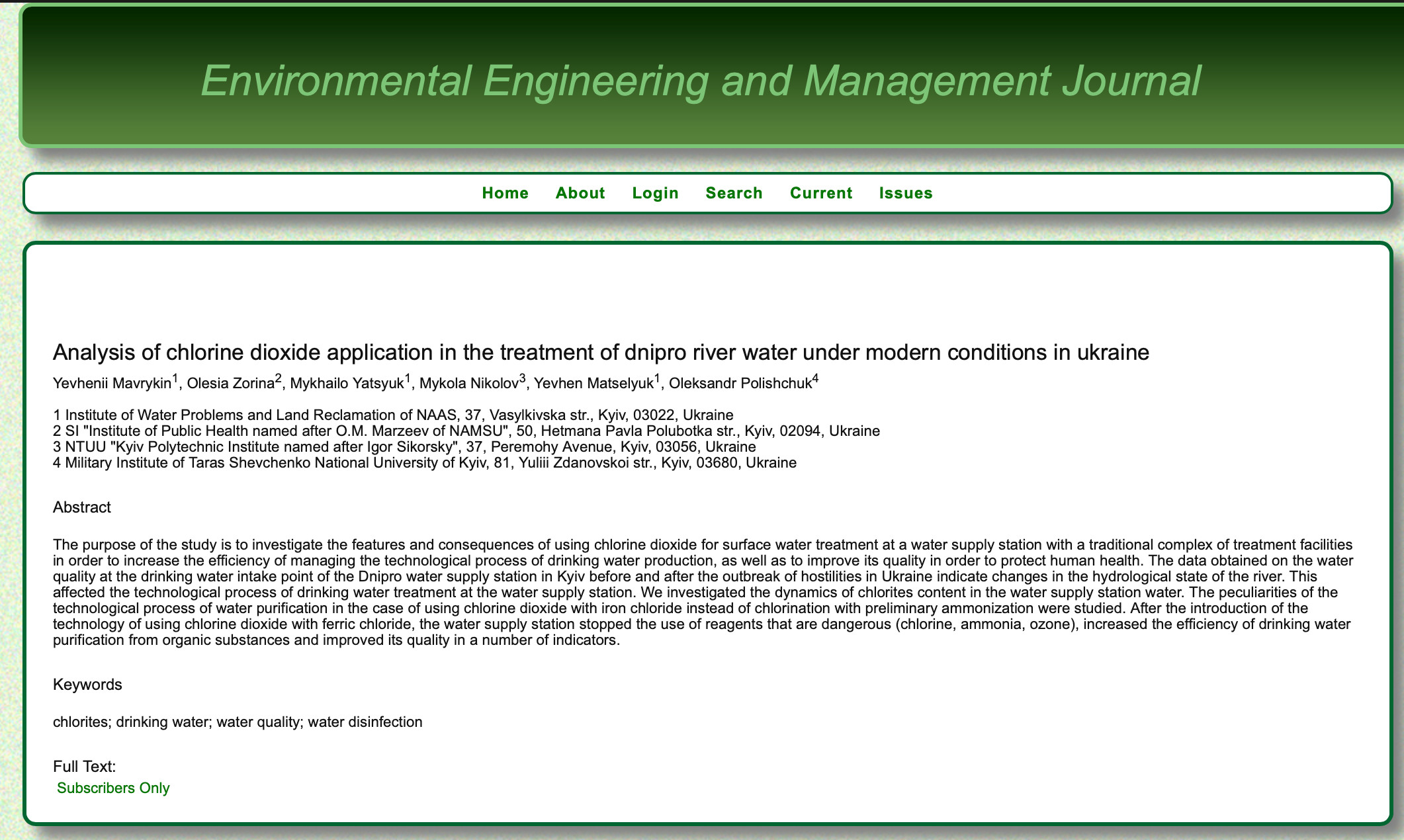
In February 2026, the international Environmental Engineering and Management Journal, indexed in the international Scopus database, published an article entitled “Analysis of chlorine dioxide application in the treatment of Dnipro River water under modern conditions in Ukraine” (link – Mavrykin E.O., Zorina O.V., Yatsyuk M.V., Matselyuk E.M., Nikolov M.O., Polishchuk O. Analysis of chlorine dioxide application in the treatment of Dnipro River water under modern conditions in Ukraine. Environmental Engineering and Management Journal. 2025. Vol. 24, No. 12. 2499-2748.
https://www.eemj.eu/index.php/EEMJ/article/view/5323).
The responsible author of the publication is the Head of the Laboratory of Surface Water Safety at the State Institution «Marzieiev Institute for Public Health of the National Academy of Medical Sciences of Ukraine,» Doctor of Biological Sciences specializing in hygiene and occupational pathology, Senior Researcher Olesia Zorina.
The purpose of the work is to study the features and consequences of using chlorine dioxide for surface water treatment at a water supply station with a traditional treatment complex in order to improve the efficiency of the technological process of drinking water production, as well as to improve its quality for the preservation of human health.
The data obtained on water quality at the water intake point of the Dnipro water supply station in the city of Kyiv before and after the start of hostilities on the territory of Ukraine indicate changes in the hydrological state of the river. While until 2021 the quality of river water corresponded to category II or III of drinking water quality (acceptable), since the beginning of 2023 it has corresponded to category III or IV of drinking water quality (undesirable). It is assumed that this is due to the destruction of critical infrastructure upstream of the water intake site as a result of hostilities on the territory of Ukraine. This has affected the technological process of drinking water treatment at the Dnipro Water Treatment Plant in Kyiv.
The features of the water treatment process at the Dnipro Water Treatment Plant in Kyiv were studied in the case of using chlorine dioxide instead of chlorination with pre-ammoniation. When introducing the technology of treating tap drinking water with chlorine dioxide in order to minimize the content of toxic chlorites, which are by-products of disinfection, divalent iron chloride can be used. However, when using this technology, it is necessary to take into account possible fluctuations in the quality of drinking water in the water supply network in terms of microbiological indicators during the warm season. This requires the introduction of an additional method of disinfecting drinking water during this period, for example, chlorination of drinking water with sodium hypochlorite in the distribution network.
It has been found that the introduction of drinking water purification technology at the Dnipro Water Treatment Plant in Kyiv using chlorine dioxide with divalent iron chloride instead of chlorination with pre-ammoniation has made it possible to: reduce the number of reagents used (from 5 to 4) by eliminating the use of hazardous reagents (chlorine gas, ammonia, ozone); improve the quality of drinking water in terms of organoleptic indicators, aluminum, and organochlorine compounds; significantly increase the efficiency of water purification from organic substances (in terms of chemical oxygen demand – more than 2 times).
It was found that during transportation of water through a water pipeline and distribution network with a length of 2 km, the concentration of chlorine dioxide decreased by half, on average from 0.16 to 0.08 mg/l, while the concentration of chlorites did not change statistically. The stable content of chlorites in drinking water during its transportation through the distribution network indicates the possibility of moving the sampling point for determining the content of chlorites in drinking water from the distribution network (consumer taps) closer to the water supply facilities (to the clean water reservoir).
The research was carried out at the Laboratory of Surface Water Safety at the State Institution «Marzieiev Institute for Public Health of the National Academy of Medical Sciences of Ukraine.»
(date of publication on the website: 06.03.2026)