
Hygiene Requirements for the Comprehensive Territorial Restoration Program: Scientific Support for the Creation of a Safe Educational Environment at the “Leader” Lyceum in Kryukivshchyna
The Laboratory of Hygiene for Planning and Construction of Settlements has developed sanitary and hygiene requirements for the Comprehensive Territorial Community Restoration Program (or a part thereof), which include the following:
- a general description of the settlement (territory) for which it is being developed, including: geographical location;
- general socio-economic assessment;
- general environmental assessment;
- number of permanent residents;
- number of temporarily displaced persons;
- information on the availability of urban planning documentation within the territorial community (or part thereof), an analysis of its relevance and the extent of its implementation;
- an analysis of negative impacts (including hostilities, terrorist acts, sabotage, and emergencies) that led to the need to develop the program;
- analysis of the negative impacts that led to the need to develop the program on the traditional character of the environment, historical areas of settlements, cultural heritage sites, the environment, nature conservation areas, and sites;
- analysis of the territory’s resources for restoring the functioning of the territorial community (or part thereof);
- information regarding the need to prepare the territory (including demining, demolition of destroyed buildings and structures, and land reclamation);
- information on the damage caused by hostilities, terrorist acts, sabotage, and emergencies:
- to residential real estate and public facilities;
- industrial facilities (manufacturing, agriculture, etc.);
- social sector facilities;
- cultural heritage sites and cultural infrastructure;
- housing and utilities facilities;
- engineering, transportation, and energy infrastructure, electronic communications network infrastructure, and water management infrastructure (including the engineering infrastructure of land reclamation systems);
- the natural environment and natural resources;
- civil defense shelters;
- other facilities that affect the functioning of the relevant territory of the territorial community (or part thereof) (if applicable).
With the aim of improving hygiene, anti-epidemic, and urban planning criteria regarding the safety of educational spaces by creating civil defense conditions in general secondary education institutions in Ukraine under martial law, taking into account international experience, a scientific report has been developed and implemented “Sanitary and Hygienic Requirements for Protective Structures in General Secondary Education Institutions under Martial Law,” which were incorporated into DBN V.2.2-5:2023.
The practical implementation of these strategic requirements at the local level began with the improvement of safety criteria directly within the educational environment, which allowed for the integration of updated sanitary and hygienic standards into actual projects for protective structures.
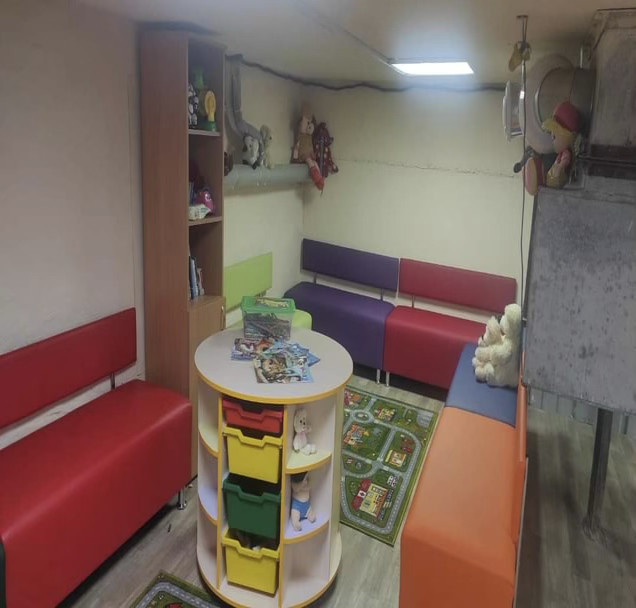
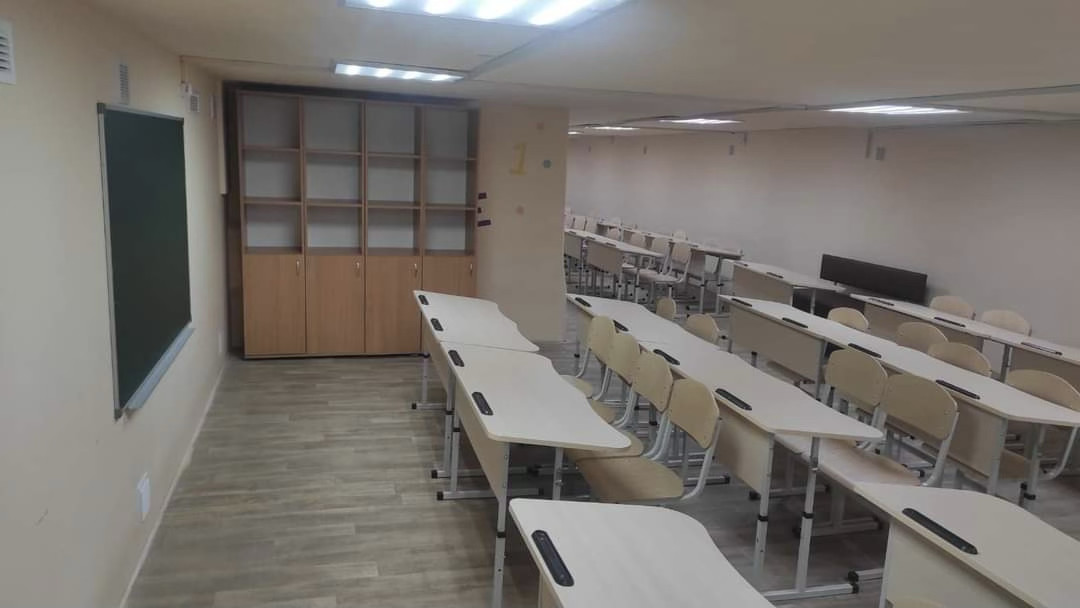
As part of research work, laboratory specialists conducted practical testing of the developed requirements for the Comprehensive Recovery Program regarding the construction of civil defense shelters by providing scientific support for the modernization of an adapted basement at the “Leader” Lyceum in Kryukivshchyna, Vyshneve City Council, Bucha District, Kyiv Region.
A set of measures was implemented to adapt the basement in accordance with the requirements of DBN V.2.2-5:2023 “Civil Defense Structures,” the State Emergency Service of Ukraine dated June 14, 2022, No. 03-1870/ 162-2, and sanitary and hygienic requirements for dual-purpose structures.
A powerful ventilation system with air temperature control has been restored, and a modern drainage network has been installed to protect the premises from groundwater, preventing the formation of mold and mildew.
The shelter is equipped with a restroom, hot water supply, hand dryers, Wi-Fi, kettles for making hot drinks, plenty of outlets for charging gadgets, a supply of certified drinking water, and a first-aid kit.
The shelter is equipped with an alert system that allows any information to be communicated to students in a timely manner.
During power outages, the shelter is provided with uninterrupted power supply via a powerful generator.
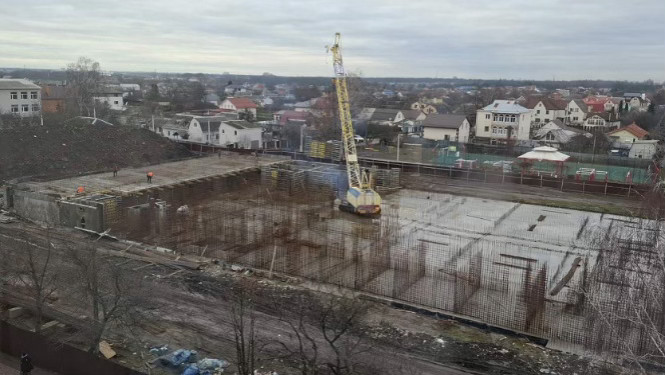
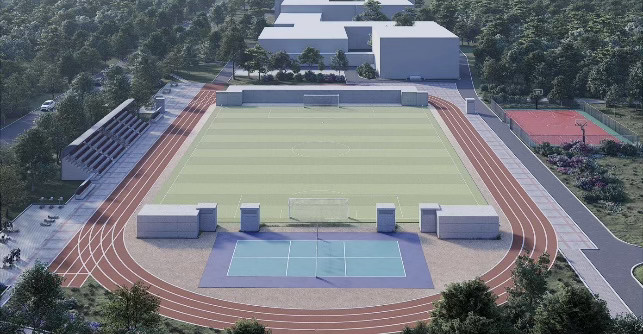
In 2025, construction began on the school’s sports field of a new civil defense shelter with the protective properties of a radiation shelter (RS), in accordance with the region’s Comprehensive Recovery Program, with the aim of creating a modern protective structure and ensuring the physical safety of students, school staff, and the local population from external threats.
According to the design documents, the protective structure is designed as a frameless structure with monolithic reinforced concrete load-bearing longitudinal and transverse walls. The total area of the RSP is 3,171.1 m², with a capacity of 1,043 students, Class A-IV. The protective structure includes separate classrooms for the upper school (grades 5–11) and rooms for the lower school, which will be equipped with children’s beds. The provision of autonomous life support systems (generator, water supply, etc.) will ensure compliance with anti-epidemic protocols even in critical situations.
The design solution provides for the rational use of the site: a modernized sports field is planned to be built above the underground section of the shelter.
Creating a space adapted to the needs of children of different ages and establishing comfortable visual and physical conditions will help stabilize students’ psychological and emotional state, reducing cortisol (“stress hormone”) levels in children, and prevent the development of psychosomatic disorders and post-traumatic conditions caused by stressful situations.
Integrating a sufficient number of learning spaces directly into the protective structure – with safe, well-lit rooms that meet appropriate sanitary and hygienic standards – will allow for the implementation of educational plans without forced interruptions, which is crucial for maintaining the quality of education and ensuring the cognitive health of children.
Construction of the lyceum’s new protective structure has now begun on the site of the existing, outdated sports field, with ongoing scientific support provided by staff from the Laboratory of Hygiene for Planning and Construction of Settlements.
Scientific support is aimed at ensuring compliance with regulated medical and sanitary requirements, namely: the location of the protective structure within walking distance, with entrances no more than 100 m from the school building; optimization of functional zoning and the necessary set of rooms; compliance with regulatory standards for the per-person floor area of main rooms; installation of autonomous power supply systems and artificial lighting with a natural light spectrum; installation of utility networks for water supply, sewage, and forced supply and exhaust ventilation; provision of the required number of emergency exits (more than two), with at least one leading outside the building perimeter; ergonomic furniture designed to accommodate students’ age and anthropometric characteristics; equipment capable of continuous operation; ensuring an inclusive environment by creating a barrier-free space and adhering to universal design requirements for unimpeded access by people with limited mobility; implementation of a visual navigation system and standardized marking of evacuation routes and functional zones of the building using photoluminescent materials and audible signals. In addition to solutions for ensuring medical and sanitary requirements, the scientific support includes the practical implementation of safe behavior algorithms—“Path to Shelter” and “Triangle of Life”—which define the sequence of actions for participants in the educational process in the event of an air raid alarm or limited access to the main protective structure.
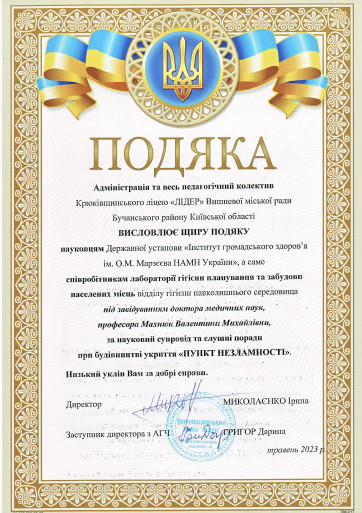
For their significant contribution to creating a safe educational environment, specifically regarding the fulfillment of medical and sanitary requirements within the dual-purpose facility located in the school’s basement, staff members of the Laboratory of Hygiene for Planning and Construction of Settlements at the Institute received an official letter of appreciation from the administration of the Kryukivshchyna Lyceum “Leader.”
(date of publication on the website: 27.03.2026)